

What Was The Makeup Of The Senate When Nixon Resigned
On July 28, 1974, the House Judiciary Committee passed the first of three impeachment articles against President Richard Nixon. Although a final House vote never took place along with a Senate trial, plans were being made for these events.
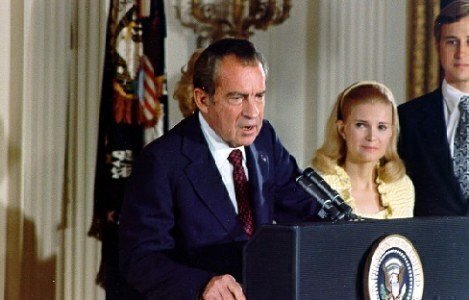 Still, President Nixon resigned on August 9, 1974 subsequently a Supreme Courtroom decision compelled Nixon to released unedited Watergate tape transcripts that included incriminating show.
The House committee had debated the impeachment articles for nigh vii months, and the grouping approved the first article past a 27-11 vote, on July 28, 1974. On the aforementioned twenty-four hour period, the Washington Mail reported some details about what would happen down the road if Nixon fought the charges.
The Judiciary Commission still needed to write a report for the full House almost the charges and go the House Rules Commission to set up debate rules. Two weeks of debate were expected under the rules, with the final impeachment vote expected near August 24, 1974. (The Postal service said that House member Tip O'Neill believed the Nixon impeachment articles would pass a full House vote by at least fifty votes.)
If the House approved whatsoever of the three articles, President Nixon would have been provided fourth dimension to form a defense, with the Senate trial lasting about two months.
The Mail besides said the Senate leaders Mike Mansfield and Hugh Scott were set to come across the next day to start planning for a possible trial.
Just on August two, the Business firm Rules committee said that the start of the floor debate would exist later, on August 19, with the total report due to all Business firm members on Baronial 8, 1974 – the twenty-four hour period that Nixon would later announce his resignation to a national audience.
In a 1985 interview, the old Secretarial assistant of the Senate, Francis Valeo, spoke near the Senate's tentative plans.
Valeo said that in general, Mansfield, the Senate leader, was worried near Nixon's behavior. "Finally, I got the society from Mansfield, but I'm certain he must have had Scott's concurrence in it, to outset planning for the trial in the Senate, because information technology seemed to be a foregone determination that [Nixon] would be impeached in the Business firm," Valeo said.
Mansfield agreed that whatever trial needed to be televised, and Valeo started working with the press on credentialing and the configuration of the Senate floor. "Nosotros were prepared to become ahead with the trial. I mean, physically we had figured out what would be done past that time. But of grade Nixon resigned and that inverse the equations," Valeo said.
Senate parliamentarian Floyd Riddick also started a series of meetings to revise the chamber's impeachment rules for a possible Nixon trial. The rules were published in September 1974 after Nixon's resignation.
James St. Clair, Nixon's chief defense lawyer, had been expected to stand for the President at any Senate trial. St. Clair had besides argued the losing instance in the Supreme Court nigh the Watergate tapes and had represented the President during the Business firm proceedings.
Chief Justice of the United States Warren Burger would preside over whatsoever Senate impeachment trial. Burger was appointed to the Court by Nixon in 1969, but he likewise wrote the unanimous determination that forced Nixon to release the total Watergate tapes. Firm members would serve as managers to argue for the impeachment articles in the Senate.
At least two-thirds of the Senate would take needed to captive Nixon on at least one of the three impeachment articles to force his removal from part. On paper, the Democrats were at least ten votes short of having such a supermajority on party lines, but Nixon'southward advisers were already telling him in early Baronial that the House impeachment vote was near certain and a Senate conviction was a distinct possibility.
The release of the Watergate record transcripts on August 5, 1974, fabricated Nixon'due south resignation inevitable, said the Washington Mail on its front page on August 9, the day Nixon officially resigned.
"It seemed inevitable then that this would be his last week in role, still he continued to fight dorsum and to insist that he would non resign. On Tuesday, the President held a Chiffonier meeting and told his official family that he would non resign," the Mail service said. "On Wed, nevertheless, the stop appeared near, for his support on Capitol Hill was disappearing at dizzying speed. There were demands from some of his staunchest supporters that he should resign at in one case."
But on August 3, Nixon speechwriter Ray Price worked on draft remarks for an accost that Nixon could give if he had decided to confront a Senate trial.
"I shall run across the Constitutional procedure through — whatever its issue. I shall appear before the Senate, and answer under oath before the Senate any and all questions put to me there," the voice communication said. Nixon apparently was never shown the draft remarks. Instead, Price worked with the President on his resignation speech several days later.
Scott Bomboy is the editor in chief of the National Constitution Center.
Source: https://constitutioncenter.org/blog/what-would-a-nixon-impeachment-trial-have-looked-like
Posted by: wolfewhisce.blogspot.com
0 Response to "What Was The Makeup Of The Senate When Nixon Resigned"
Post a Comment