

How To Draw A Bass Guitar Simple
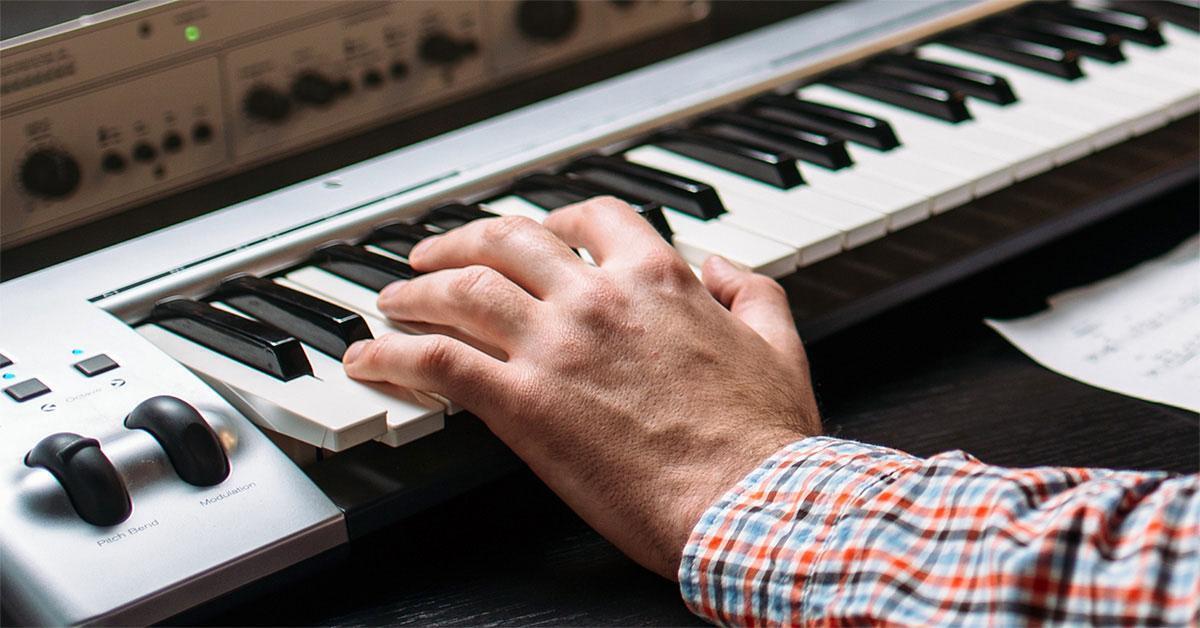
Although I play bass, I mostly prefer using keyboard bass on recordings, not because I'm a better keyboard histrion, but because I've sampled and so many basses information technology's always possible to observe a suitable bass sound within seconds — no plugging, unplugging, tuning, maintenance, or figuring out where to store dozens of basses. And interestingly, many listeners enquire which bass I'chiliad playing, because they like the sound. They're always somewhat shocked when they find out I've been hitting keys, not strings.
So what'south the secret of realistic MIDI bass parts? Glad you lot asked — get the lowdown with these five tips.
1. Hangovers Are Bad for You
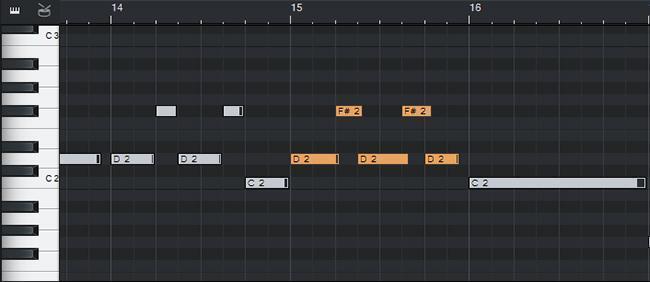
Fig. 1: The orange notes overlap the attacks of subsequent notes. The white notes are trimmed to avoid this.
Most bass lines are single notes, and because bassists lift fingers, mute strings, and pick, in that location's going to exist a space between notes. Go through your MIDI sequence annotation by note and make sure that no note extends over another notation'south attack (Fig. 1). If two notes play together, you'll hear a momentary note collision that doesn't sound like a real bass. I'll even increment the gap betwixt notes slightly if the notes are far autonomously.
ii. Putting on the Squeeze
Bang-up bassists are known for their touch on — the power to play notes with consistent timing and dynamics. It tin can sometimes exist harder to play keyboard notes consistently than bass strings, which brings united states of america to MIDI velocity compression.
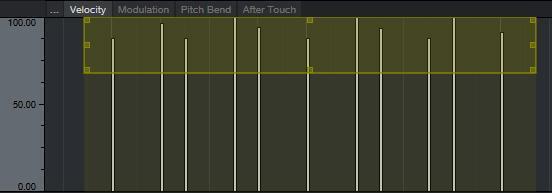
Fig. 2: Studio One's Transform tool makes it easy to shrink values by raising the tool'south lower boundary.
Sound compression can give more consistent levels, but it doesn't give a more consistent bear on; that has to happen at the source. Some recording software programs have either MIDI FX or editing commands to compress data by raising low-level notes and/or reducing loftier-level notes (Fig. 2). But if your program doesn't have velocity compression, there's an easy solution: add a abiding to all velocity values for "MIDI limiting."
For example, suppose the bass function's softest annotation velocity is 70, and the highest is 110 — a divergence of 40. Add 35 to all values, and now your softest velocity is seventy+35=105, and your highest is 110+35=145, just velocity can't become higher than 127 — so yous have instant "MIDI limiting." Now your highest-velocity note is 127, and at that place's only a difference of 22 between the highest and lowest notes. If you want to go back to making sure the highest-level note is 110, then subtract 17 from all values. Your highest-level notation is now at 110, but the everyman-level note is 88 — nevertheless a difference of 22 instead of 40.
This doesn't necessarily preclude adding audio pinch, simply you'll probably need to add less of it, and the sound will be more than natural.
These kinds of techniques work, perhaps with slight modifications, with many software programs. For example, when editing MIDI dynamics, although Studio Ane's Transform tool shown to a higher place gives very intuitive visual feedback, Cubase and Digital Performer have very flexible ways to control MIDI dynamics, and Ableton Live'south Velocity MIDI effect even lets you sculpt velocity curves.
3. Hey, It's a Synth Bass
…which means you lot can probably modulate synth parameters with velocity. When creating sampled bass instruments, rather than go through the hassle of multi-sampling different velocities, I sample each private note plucked strongly and then tie sample offset time, level, and filter cutoff to notation velocity to create the dynamics. Although the audio may arguably non exist as realistic as something with 4 billion circular-robin samples, I discover this approach to be more expressive overall because any synth module changes tied to dynamics are continuous.
four. Slippin' and Slidin'
Slides are an of import bass technique — not just slides up or down a cord, but over a semitone or more than when transitioning between notes. For example, when going from A to C, you tin can extend the A MIDI note and use pitch curve to slide it upwards to C (think to add together a pitch curve of 0 afterward the annotation ends). Also, all my sampled bass instruments take sampled down and upward/downwardly slides for each string. Throw those in from time to time, and people swear it'southward a real bass. Unless you're emulating a fretless bass, you desire a stepped, non continuous, slide to emulate sliding over frets, but yous don't want to re-trigger the notation at each pace. There are several means to do this.
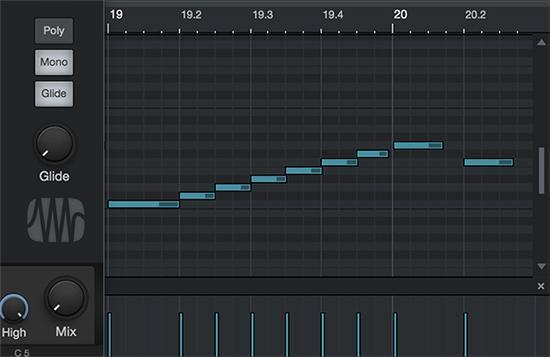
Fig. 3: Studio Ane's Presence XT instrument has glide. Enable information technology, set a very short glide time, and add a very slight overlap betwixt notes — the 1-measure out slide shown here goes from C to 1000. The last note does not overlap with the Yard; this gap between notes allows the G note to re-trigger.
- If the bass instrument has a legato manner, you tin exercise a slide by adding notes at individual semitones to create the slide, and then using legato way to avoid having the notes re-trigger. Legato mode does crave an overlap between notes, but it can be very short.
- Glide will too piece of work nether the same conditions, but you demand to fix the Glide time to minimum (Fig. 3).
If your plan doesn't interpolate between pitch-bend letters (or you can turn off smoothing for the pitch-curve function), quantizing pitch-curve slide messages and so they're stepped is some other solution, merely this ane doesn't require entering actress notes. For instance, with a virtual instrument'south pitch bend fix to +/-12 semitones, quantizing the bend to 1/32 triplets will requite exactly 12 steps in an octave-upward slide that lasts ane beat, while a 1/16 note triplet gives 12 steps in an octave-up slide that lasts two beats, or - Just draw a stepped pitch bend.
And so over again, you might want to emulate a fretless bass and take continuous slides.
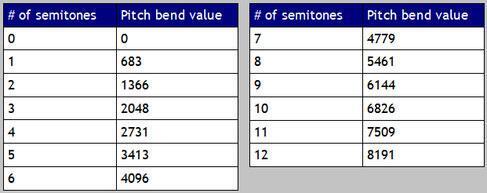
Fig. 4: Employ these pitch-bend values to slide a precise number of semitones.
For precise slides, Figure 4 shows the amount of pitch-curve modify per semitone when using a pitch-bend range of +/-12 semitones (recommended for bass to brand these kinds of slides possible). For example, if an octave is a pitch-curve value of 8191 and you lot desire to start a slide three semitones above the note where you want to land, start at a pitch-bend value of +2048 and cease with a pitch-curve value of 0. If you desire to step the function (this assumes you can turn off pitch-curve smoothing or enter precise values in an Consequence Listing), add together equally spaced events at +1366, +683, and simply before the final notation, 0.
5. Mod Wheels Are Non for Vibrato
Dubstep people have figured this out — they eschew vibrato for tremolo or "filtrato." With bass, I use the mod wheel for what I feel are more useful effects:
- Roll off treble as the wheel rolls farther away to emulate a traditional bass tone control
- Mix in a sub-octave for an octave-divided bass audio
- Alter tremolo depth to add pulsed tremolo sparingly
- Increment bulldoze to an amp sim to give more "growl"
Because you'll likely exist playing unmarried notes for bass line, your other mitt will be free to work the mod wheel and increase expressiveness fifty-fifty farther — and that's a skillful thing.

Source: https://www.sweetwater.com/insync/create-realistic-midi-bass-parts/
Posted by: wolfewhisce.blogspot.com
0 Response to "How To Draw A Bass Guitar Simple"
Post a Comment